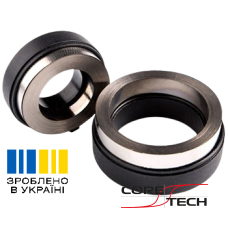
Amorphous alloys are a special class of precision alloys that differ from crystalline alloys in structure, manufacturing method, and set of physical properties. In the structure of amorphous alloys, there is no periodicity in the arrangement of atoms. Compared to crystalline metal, amorphous alloys are several times stronger, have higher corrosion resistance and better electromagnetic properties.
The amorphous state is achieved by selecting the chemical composition of the alloy and using a special technology of ultra-fast cooling at a speed above the critical speed, for which the initial melt is poured onto a rapidly rotating disk. When the melt hits the surface of the disk, it cools at a rate of about 106 K/s and turns into a ribbon with a thickness of 15 to 60 mm, has an amorphous structure similar to the structure of glass. Magnetic conductors of the desired shape and size are formed from the tape. Giving materials specific properties (for example, a hysteresis loop of a certain shape) is achieved by thermal or thermomagnetic treatment, as a result of which the structure of the tape can remain amorphous, become partially crystallized or nanocrystalline.